
Table of Contents
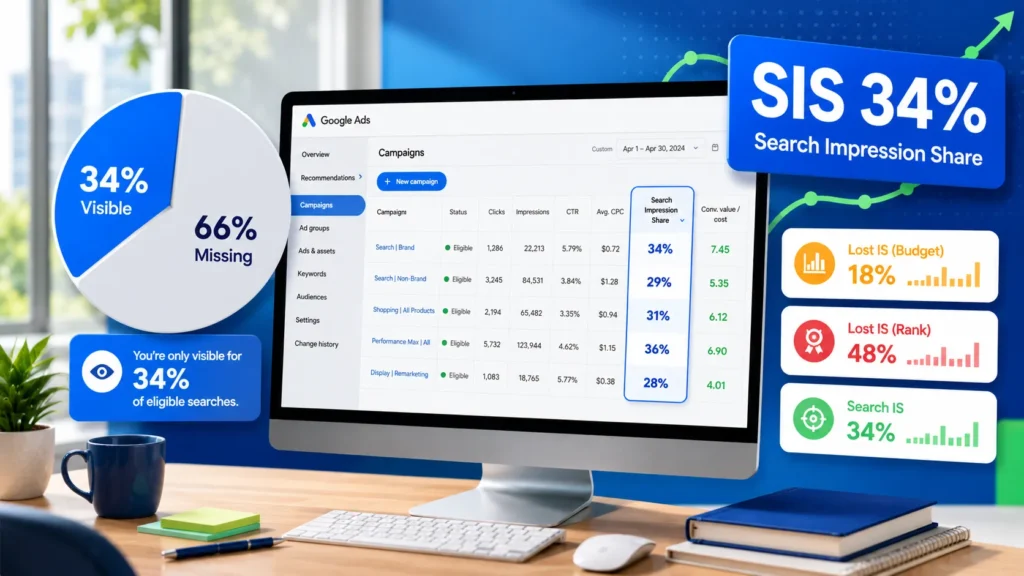
If your Google Ads were visible in only 1 out of every 5 relevant searches, would you know?
Most SME owners are reviewing clicks, CTR, and cost-per-click every week. These numbers feel real. But none of them tells you how much of your potential market your ads are invisible to.
That number is Search Impression Share (SIS). By the end of this article, you will know your SIS, understand exactly what is draining it, and know what to do about it.
Table of Contents
ToggleSearch Impression Share in Google Ads: What It Is and Why Most Business Owners Never Check It
The Difference Between Clicks, CTR, and Actual Market Visibility
Clicks tell you how many people came through. CTR tells you what percentage of people who saw your ad actually clicked. Neither number tells you how many relevant searches your ad did not appear in at all.
Search Impression Share fills that gap. It measures the percentage of eligible searches where your ad actually showed up. If your SIS is 20%, your ads are missing 80% of the auctions you qualified for. That is not a click problem. That is a market visibility problem.
Most agencies do not surface this number to clients by default. It sits in a column that is easy to overlook inside the Google Ads interface. Here’s the real issue: if you are not measuring market visibility, you are optimising in the dark.
What 'Eligible Impressions' Actually Means — and Why It's Not Every Search
Eligible impressions are not every search that happens on Google. They are the specific auctions your campaign qualified for, based on your keyword targeting, location settings, device targeting, and campaign status.
If someone searches for a product you sell, but your keywords do not match that query, that search is not in your eligible pool. Your SIS is calculated against the auctions you were actually entered into, not the total search volume for your category.
This distinction matters. A low SIS score does not always mean you need more keywords. It often means you are losing auctions you already qualify for, due to budget or quality issues. Fix this first before expanding your targeting.
The Search Impression Share Formula: How to Calculate It and Read It Like a Business Owner
Search Impression Share is straightforward to calculate. Google computes it automatically inside your Google Ads account, but understanding the formula helps you read the number correctly.
The formula is:
SEARCH IMPRESSION SHARE FORMULA Impressions Received ÷ Total Eligible Impressions × 100 = Search Impression Share % Source: Google Ads Help, 2026 |
Impressions Received is the number of times your ad actually appeared. Total Eligible Impressions is the estimated number of auctions your ad could have entered, based on your targeting settings and current bids. The result is a percentage. You can find this data in the Columns view inside Google Ads Help.
A score of 30% means your ads appeared in 3 out of every 10 auctions you qualified for. The other 7 went to a competitor, or your ad simply did not appear. That gap is your growth opportunity.
The Three SIS Metrics You Need to Track (and What Each One Tells You)
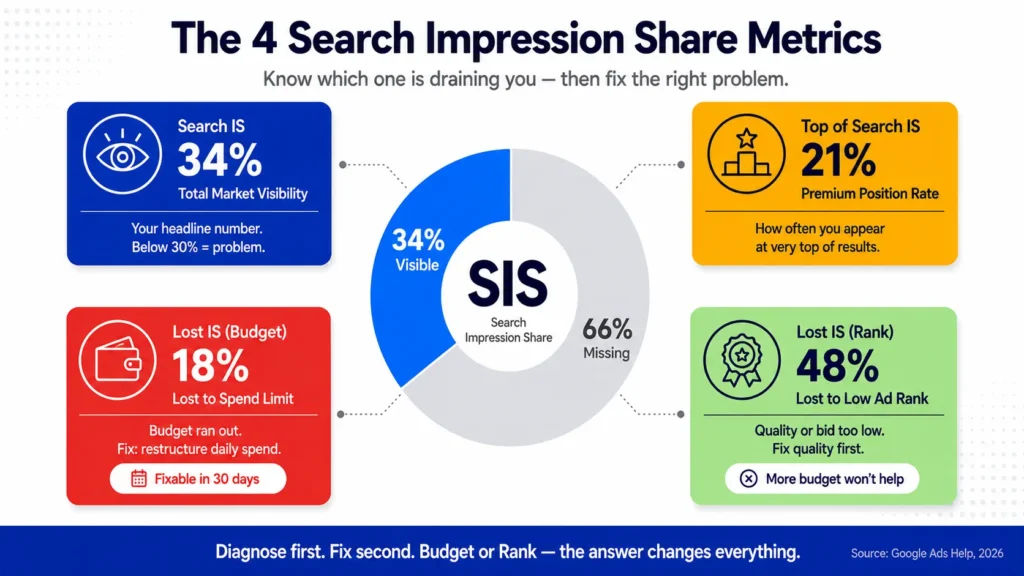
Google breaks Search Impression Share (SIS) into three distinct metrics. Each one tells you something different about where your campaigns are losing ground.
Matric 1
Search IS — Total Visibility
Search IS is the overall percentage of eligible impressions your ads received. This is the headline number. Across accounts we manage, businesses with SIS below 30% are consistently losing significant market presence that they have already paid to qualify for.
Matric 2
Lost IS (Budget) — Visibility Lost to Insufficient Spend
Lost IS (Budget) is the percentage of eligible impressions your ads missed because your daily budget ran out. Google stops showing your ads once the budget is exhausted. This metric tells you exactly how often that is happening.
Matric 3
Lost IS (Rank) — Visibility Lost to Low Quality or Bids
Lost IS (Rank) is the percentage of eligible impressions your ads missed because your Ad Rank was too low to compete. Ad Rank is determined by your bid, your Quality Score, and the expected impact of your ad extensions. A high Lost IS (Rank) means Google does not consider your ad relevant or competitive enough.
Want to know your current SIS score? Run a free audit at adbiliti.com/services/google-ads-audit/
Search Impression Share Lost Due to Budget vs. Rank: Why the Diagnosis Changes Everything
Here is where most SME owners get stuck: They know their impression share is low, but they do not know why. The fix for a budget problem is completely different from the fix for a rank problem.
Treating a rank problem with more budget does not work. Treating a budget problem by rewriting ad copy does not work either. The diagnosis has to come first.
If Your Loss Is Budget-Driven: What to Adjust First
A high Lost IS (Budget) score means your ads are competitive. Google is willing to show them. You are simply running out of money before the day ends.
Fix this first. The options are:
- increase the daily budget,
- narrow your targeting to concentrate spend on your highest-converting hours or locations,
- Pause lower-priority campaigns to redirect budget to your core earners.
One of our clients was losing 62% of eligible impressions to budget. Their ads were competitive, but kept disappearing mid-afternoon as spend ran out. Within 30 days of restructuring their budget allocation, their SIS climbed from 18% to 54%. The account structure did not change. The ads did not change. The budget structure changed.
If Your Lost IS Is Rank-Driven: How Quality Score and Bid Strategy Work Together
A high Lost IS (Rank) score is a signal that Google views your ads as less relevant than your competitors. Increasing your budget here does not help. You are losing auctions before budget even becomes a factor.
The immediate lever you have is your bid, but it comes at a price. Since Ad Rank is a product of your bid multiplied by your Quality Score, you can technically “buy” your way back into the auction by increasing your Max CPC bids.
Know More About CPC:… (related blog link)
A longer-term, more sustainable fix involves improving your Quality Score, which Google calculates based on expected click-through rate, ad relevance, and landing page experience. You can also adjust your bidding strategy to be more competitive on your highest-intent keywords while reducing spend on lower-priority terms.
This is why the numbers look good but feel wrong. Your clicks are steady and your CPC looks reasonable, but your ads are missing most of the market. Once again, Rank-driven losses are often invisible until you look at the SIS column.
Not sure if you are losing IS to budget or rank? We can check in 20 minutes — book a free audit.
How a Google Ads Strategy Built Around Impression Share Grows Market Share Faster
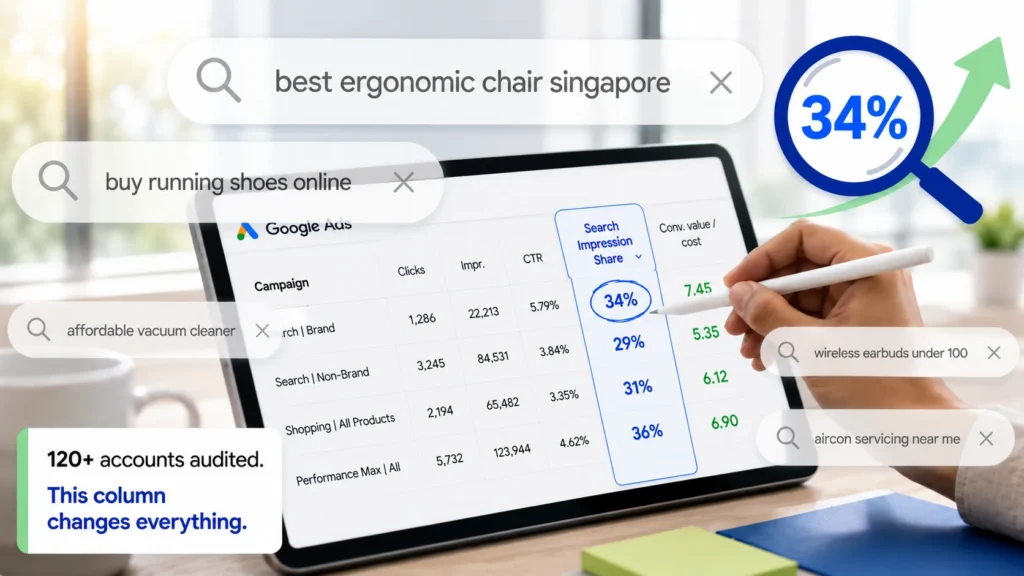
Most Google Ads strategies are built around click volume or cost-per-lead. These are outcomes. Search Impression Share is a structural metric. It tells you whether your campaign architecture is actually capturing the market you are targeting.
When SIS is the central metric, budget decisions become clearer. Bid changes become more deliberate. Campaign structure becomes easier to evaluate. Explore our Google Ads managed service to see how we structure campaigns within 20 minutes around this metric from day one.
The Adbiliti SIS Audit: What We Look For in the First 20 Minutes
In the first 20 minutes of any audit, we pull the SIS column and split it by campaign. We look at Lost IS (Budget) and Lost IS (Rank) separately. We identify which campaigns are budget-constrained and which are quality-constrained.
This distinction drives everything else. We show you this data in the first conversation — not as a dashboard number, but as a business visibility metric. You leave knowing exactly where your market presence is leaking and what needs to change first.
As a certified Google Partner agency, our audits are grounded in Google’s own platform data. Across all our SME accounts we manage, the ones that track SIS consistently have fewer wasted spend surprises and steadier lead volume.
This distinction drives everything else. We show you this data in the first conversation — not as a dashboard number, but as a business visibility metric. You leave knowing exactly where your market presence is leaking and what needs to change first.
Setting SIS Targets: What a Healthy Score Looks Like by Industry and Budget Tier
There is no universal SIS target that applies to every business. A competitive e-commerce brand in a saturated category may operate at 40–50% SIS and still outperform competitors. A local service business with tight geographic targeting may achieve 70%+ SIS on a modest budget.
What we know from the accounts we manage: anything below 30% SIS with high Lost IS (Budget) is almost always recoverable within 60 days of proper budget restructuring.
You can read more about how ad quality and structure affect your results in our Google Ads Audit service page.
Frequently Asked Questions: Search Impression Share in Google Ads
Search Impression Share is calculated as: Impressions Received ÷ Total Eligible Impressions × 100. Google calculates this automatically in your account and displays it in the Campaigns or Ad Groups columns view. Total Eligible Impressions refers to the auctions your campaign qualified for based on your targeting, bids, and quality — not all searches in your category. The official definition is published in Google Ads Help.
Lost IS (Budget) means your ads stopped showing because your daily budget ran out before the day ended. Google pauses your ads once the budget is exhausted, and those missed auctions count against your impression share.
The fix is to either increase your daily budget, adjust ad scheduling to concentrate spend during peak conversion hours, or redirect budget toward your highest-performing campaigns. Start by identifying which campaigns are running out of budget first — that is where the leak is.
A healthy SIS varies by industry and budget. For most SME campaigns, a score above 40% is a solid starting point. Anything below 30% typically signals a structural issue — either a budget constraint or a quality problem — that is limiting your market presence.
The more useful question is not just what your SIS is, but which type of loss is driving it. A 25% SIS with high Lost IS (Budget) has a very different fix from a 25% SIS driven entirely by Lost IS (Rank).
A specialist agency can diagnose your Lost IS split in the first audit and tell you immediately whether your loss is budget-driven or rank-driven. That distinction alone saves weeks of trial and error.
At Adbiliti, we surface this data in the first conversation and give you a clear diagnosis before any engagement begins. You can book a free Google Ads Audit, explore our managed service, or start with a Google Ads strategy call.
Claim Your Free Search Impression Share Audit Enter your website and we will show you your current SIS score, what is draining it, and a 3-step fix. Rated 4.9/5 by 60+ SME owners Book Your Free Audit → adbiliti.com/services/google-ads-audit/ Or download the 2026 SIS Audit Checklist — the formula, all four metrics, and a self-assessment scoring table. Prefer to talk? Call Us for FreePrefer to talk? adbiliti.com/google-ads-strategy-call/ |

Get Your Free Google Ads Account Audit
In 30 minutes, we will show you exactly where your budget is leaking and how to fix it.
Related Post




Walk away with clarity, not a sales pitch.
In 30 minutes, we’ll help you understand what’s working, what’s wasting budget, and what your next move should be. Free, honest, no strings attached.