
Table of Contents
Table of Contents
ToggleBackground: A Firm Built on Expertise
JDT is an established professional firm providing Management, Accounting, Tax, and Corporate secretarial services in Singapore. Led by Joe Tan, the managing partner, the firm has the professional credibility and technical depth to handle complex compliance and corporate needs for businesses of all sizes.
Despite that internal expertise, their digital presence did not reflect their capabilities. A digital marketing strategy is urgently needed, which could translate their professional reputation into a reliable and predictable pipeline of new business. What they had instead was years of silence.
The Challenge: Years of Digital Silence
Before engaging with Adbiliti, JDT had worked with a consultant for several years, who turned out to lack the technical depth required for performance marketing. The firm had not generated a new lead through digital channels in years. The budget was being spent. The reports were being produced. But nothing was connected to real business outcomes.
Here’s the real issue: There were two compounding problems, and both needed to be fixed before anything else could work.
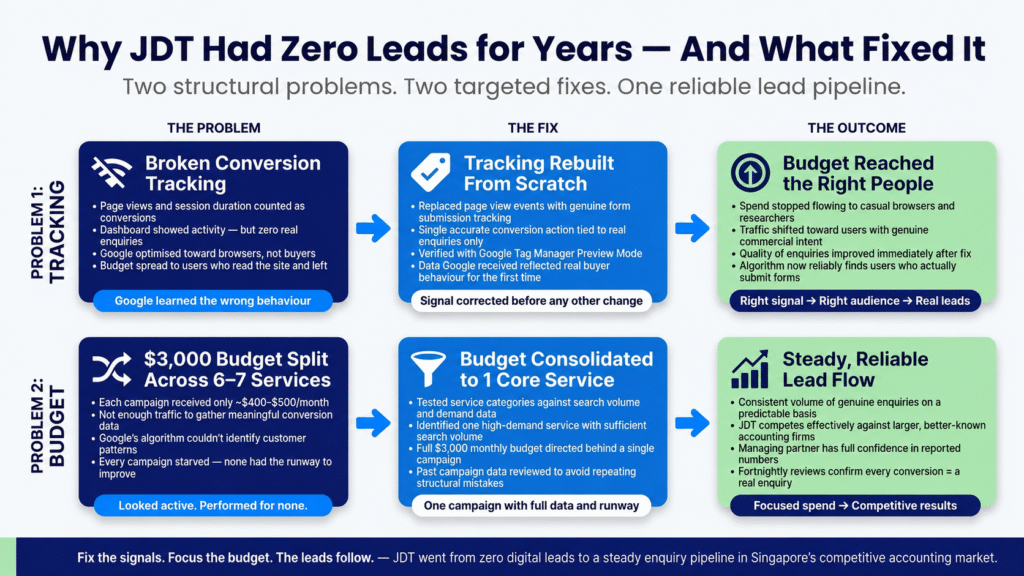
The first problem was conversion tracking. The previous consultant had set up tracking that counted page views and time spent on the site as conversion events. On the surface, the dashboard looked active. Google was recording conversions regularly. But those conversions were not enquiries. They were people browsing, reading, and leaving.
Google learned the wrong thing: it was optimising toward users who would spend time on the site, not users who would actually submit a form or make a phone call. The budget was spreading to the wrong users because the signal it was given told it that those were the right ones.
The second problem was budget dilution. JDT had six to seven services advertised simultaneously on a $3,000 monthly budget. Split across that many campaigns, each service was receiving roughly $400 to $500 a month at best. That is not enough traffic to gather meaningful conversion data, and it is certainly not enough for Google’s algorithm to learn what a good customer looks like for any one of those services. Every campaign was starved of the data it needed to improve. This is why the numbers look good but feel wrong: the account appeared active, but not a single campaign had the foundation it needed to perform.
The Approach: Fix the Signals, Focus the Budget
We started by auditing JDT’s existing setup in full. The tracking needed to be rebuilt before anything else could be trusted. We replaced the page view and session duration events with a single, accurate conversion action tied to genuine enquiry submissions. Once that was in place, the data Google received reflected real buyer behaviour for the first time.
From there, we rebuilt the Google Search campaigns from scratch, such as reviewing the past campaign data to understand what had already been tried, so we were not repeating the same mistakes with a totally fresh budget. We then tested different service categories against search volume and demand data to identify which categories had the highest chance of success.
The conclusion was clear. Rather than spreading the budget thinly across six to seven services and giving none of them a real chance, we narrowed the focus entirely to one core service with proven demand and sufficient search volume to justify the investment. All of JDT’s available budget went behind that one service, giving their campaign the data and the runway it needed to perform.
Execution
- Corrected conversion tracking from scratch, by replacing page view and session duration events with accurate form submission tracking
- Reviewed past campaign data and settings to identify what had failed and avoid repeating the same structural mistakes
- Tested multiple service categories against search volume and demand data to identify the highest-probability service to focus on
- Consolidated the services (from six to seven) down to one core service, ultimately directing the full budget behind a single campaign
- Ran fortnightly performance reviews to monitor lead quality and verify that reported conversions aligned with actual enquiries received
Let’s break this down. This part matters because every other optimisation decision in their account depends on the tracking being correct. If the conversion event learned by Google does not represent a real inquiry, then adjusting bids, changing headlines, or adding keywords will not help. The algorithm will simply become better at finding people who browse your site, not people who need your services. Fix this first, and Everything else will follow.
The budget consolidation was equally important. A $3,000 monthly budget sounds reasonable for a professional firm in Singapore. But divided across six to seven campaigns, it becomes too thin for any single one to gather enough data. When each campaign is starved of conversions, Google cannot identify patterns, cannot optimise bids toward the right audience, and cannot improve / Google cannot: identify patterns, optimise bids toward the right audience, and improve. Consolidating behind one service gave the algorithm what it had never had before/ never had before: enough signal to work with.
The Results: Stability Amidst Competition
By fixing the data and focusing the budget, JDT was able to compete effectively against much larger, well-known players in the accounting services and corporate secretarial space. This field is not a type of market where smaller firms typically expect to win on Google Ads. The bigger names have brand recognition, larger budgets, and longer track records. But a firm with clear signals and a simple, well-structured campaign outperforms even a large budget with messy data.
JDT now generates a steady and reliable volume of enquiries on a consistent basis. Joe Tan (the managing partner) has full confidence in the numbers because now the tracking reflects what is actually happening in the business, not what an algorithm decided to count as a success.
| Phase | Description |
|---|---|
Situation |
A professional firm with no digital leads for years, due to broken conversion tracking that counted page views as conversions, and a $3,000/month budget spread across six to seven services with no meaningful traffic reaching any of them. |
Approach |
Corrected conversion tracking to count only genuine enquiries. Rebuilt campaigns from scratch. Reduced from six to seven services down to one high-demand service with sufficient budget to generate and sustain results. |
Outcome |
Steady, reliable lead volume in a highly competitive market, outperforming much larger and better-known players by focusing where the signal was strongest, as well as a cleaner structure. |
“After years with consultants who didn’t deliver, we finally started seeing steady enquiries again. Adbiliti focused on one service, fixed our tracking, and made sure every dollar counted. It’s simple, effective, and built on trust.”
— Joe Tan, Managing Partner, JDT
What Changed and Why It Worked
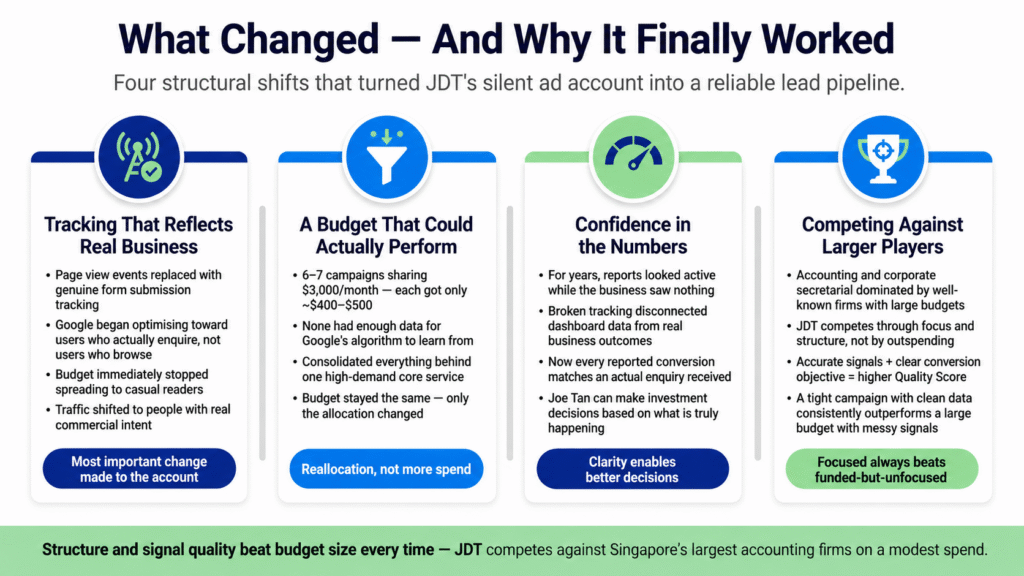
A Budget That Could Actually Perform
With six to seven campaigns sharing a $3,000 monthly budget, none of them had the data they needed to improve. Consolidating behind one service gave that campaign enough volume to learn, optimise, and produce results. The budget did not increase. The way it was allocated did, and that was what made all the difference.
Tracking That Reflects Real Business
Replacing page view events with genuine enquiry tracking was the single most important change made to this account. Once Google was optimising toward people who actually submitted a form, the quality of traffic improved immediately. The budget stopped spreading to casual browsers and started reaching people with genuine commercial intent.
Confidence in the Numbers
For years, JDT’s reporting looked active while the business saw nothing. Fixing the disconnection restored Joe’s confidence in the channel. When the dashboard shows a conversion, it now corresponds to a real enquiry. That clarity is what makes it possible to make good decisions about where to invest next.
Competing Against Larger Players
Accounting services and corporate secretarial services in Singapore are dominated by well-established firms with strong brand recognition. JDT competes by being more focused, not by outspending them. A tightly structured campaign with accurate signals and a clear conversion objective will consistently outperform a larger budget that is chasing the wrong actions.
How Adbiliti Helps
Most professional firms in the accounting and tax services space have accounts that are sending Google the wrong signals. If your primary conversion is a page view or a session duration event (just like JDT did), the algorithm will find people who browse, not people who enquire. We help by removing that low-intent noise and building a new structure that reflects real business outcomes.
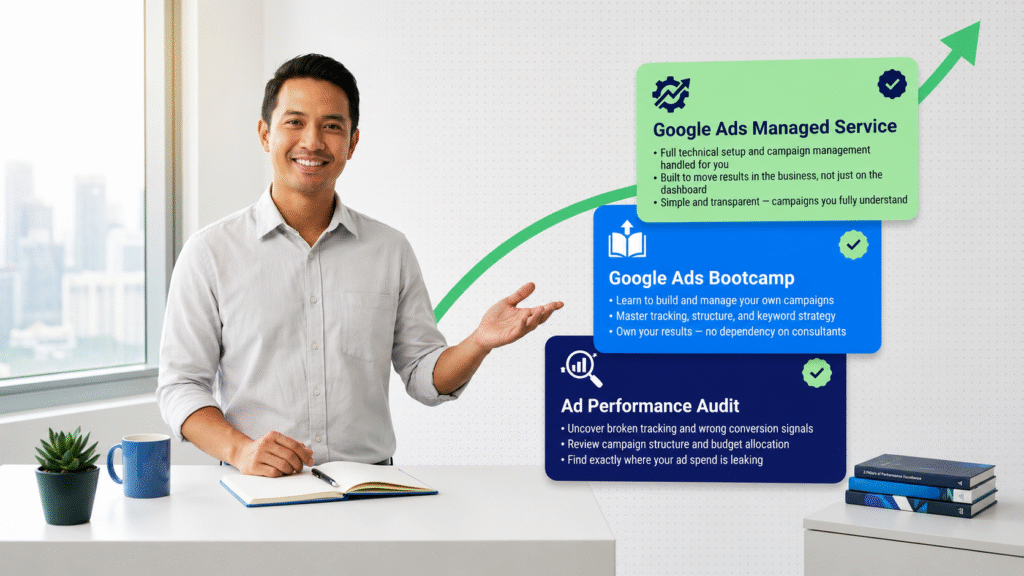
If you want to check whether your structure and tracking are correct (or even your campaigns in general), we can look at your data together. You can start with an Ad performance audit to find where the signals are breaking down. And if you want to learn how to build and maintain this yourself, our Bootcamp covers the fundamentals. For those who want the technical work handled properly from the start, But if you feel lost or clueless, and want to be handled properly from the start, especially on the technical work, our Google Ads managed service is built to get results moving in the business, not just on the dashboard.
Frequently Asked Questions: Google Ads for SMEs (Based on JDT Case)
The easiest way to check is to compare what Google Ads reports against what you actually received. If Google says you got 20 form enquiries this month but you only recall seeing 10 in your inbox, something is wrong. A common cause is tracking events that do not reflect real buyer intent: page views, session duration thresholds, or scroll depth. These fires are frequent and make the dashboard look active, but they are actually not leads. As a consequence, Google will optimise toward users who trigger these events, which means it learns to find browsers, not enquirers. Hence, use Google Tag Manager’s Preview Mode to test your tracking by submitting a real enquiry on your own website and confirm the conversion tag fires exactly once on that action and only that action. For professional services firms in Singapore, getting this right before spending more money on ads is essential.
If your monthly budget is limited, the honest answer is no. When you spread your budget across too many services at once, each campaign gets too little data to improve. A $3,000 monthly budget divided across six or seven services leaves each campaign with roughly $400 to $500 a month. That is not enough traffic to gather meaningful results, and it is not enough for Google’s algorithm to identify who your best customers are for any given service. A smarter approach is: start with the one service that has the highest search volume and the clearest commercial intent, build one solid campaign around it, get it working reliably, and only then consider adding a second. One campaign done well will always outperform six campaigns done poorly.
Target keywords that show someone is ready to take action, not just doing research. Good examples include company incorporation in Singapore, an accounting firm for SME Singapore, corporate secretary in Singapore fees, and GST registration in Singapore. Avoid broad terms like accounting or Singapore company, which attract students, job seekers, and people doing general research with no intention of hiring anyone. Use phrase match and exact match types, and build a solid negative keyword list to block irrelevant traffic. Terms like: accounting jobs, accounting software, accounting course, and free accounting template will all drain your budget without ever turning into a real enquiry. By checking your Search Terms Report every fortnight, you will see what irrelevant searches have been triggering your ads and allow you to block them.
For most SMEs in Singapore, a fortnightly review works well. It is frequent enough to catch problems early, but not so frequent that you are making changes before the data is meaningful. Google’s algorithm needs time to learn, and if you adjust bids, pause keywords, or change budgets every few days, you are effectively restarting the learning process each time. During each fortnightly review, look at three things:
- How many actual enquiries came in compared to what the platform reported?
- What each lead costs you? and
- Which search terms triggered your ads?
That last one often reveals wasted spend that has been hiding in plain sight for weeks.
You do not need a larger budget. You need a sharper focus. Large firms tend to run broad campaigns across many services and rely on brand recognition to carry the result. Your advantage as a smaller firm is that you can be extremely specific. Pick one service, one type of client, and write an ad that speaks directly to their situation. A highly targeted ad pointing to a well-designed landing page will consistently outperform a generic ad from a bigger brand, because Google rewards relevance with a better Quality Score, which means lower cost per click for you. Add a clear and concrete offer, such as a fixed-fee package or a free initial consultation, and you will find that focused spending generates very competitive results even against firms with significantly larger budgets.
Claim Your Google Ads Audit (Free) Enter your website and we will show you your current stats, what’s draining it, and fix steps. Rated 4.9/5 by 60+ SME owners |

Get Your Free Google Ads Account Audit
In 30 minutes, we will show you exactly where your budget is leaking and how to fix it.
Related Post





Walk away with clarity, not a sales pitch.
In 30 minutes, we’ll help you understand what’s working, what’s wasting budget, and what your next move should be. Free, honest, no strings attached.