
Why Google Ads Feels Unpredictable in 2026, And What Singapore SMEs Should Do About It
Table of Contents

You did everything Google told you to. You set a budget, picked keywords, launched and watched your cost-per-click climb while your conversions stalled.
You did everything Google told you to. You set a budget, picked keywords, launched and watched your cost-per-click climb while your conversions stalled.
You are not alone. Google Ads in Singapore has changed significantly in the past two years. AI Max and Performance Max have replaced much of the manual control advertisers relied on. And the reports that used to explain what was happening now show less data than before.
This is not a reason to abandon Google Ads. It is a reason to understand what changed. By the end of this article, you will know why your account feels unpredictable currently, which principles still hold, and what a well-structured 2026 account actually looks like. And If you want us to look at your account directly, you can book a free audit here.
Table of Contents
ToggleWhat Actually Changed in Google Ads in 2026 (And Why Your Old Playbook Is not Enough)
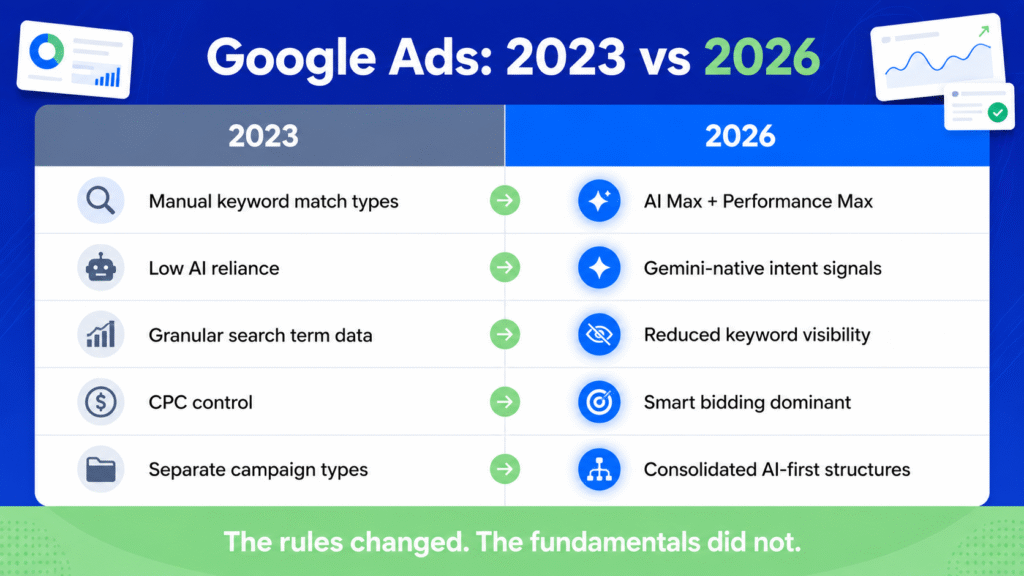
Four things shifted around the same time, and together they’re why Google Ads in 2026 feels completely different.
- AI Max and Performance Max have eaten up most of the inventory that manual Search campaigns used to control. These campaign types handle bidding, audience targeting, and creative decisions on their own. You feed them the inputs (assets, landing pages, goals) and Google’s AI figures out where to show your ads. You still have control, but it’s pushed back a layer from where it used to be.
- Intent signals have changed how Google reads search queries. It’s not matching exact phrases anymore. Instead, it’s guessing intent from context, what users did before, and what’s on the page. A keyword list that worked in 2023 might now pull in completely different users. When your account structure doesn’t adapt, Google ends up learning the wrong patterns.
- CPCs in Singapore have climbed across competitive verticals, especially education, legal, and med aesthetics. More advertisers are using smart bidding, so you’ve got automated systems competing in the same auctions. These systems tend to drive prices up because they’re all bidding hard for the same signals.
Search term reports have gotten way less detailed. Google now hides a big chunk of the actual queries that triggered your ads, saying it’s for privacy reasons. The data you used to rely on to see what’s working is only partially visible now. It makes reporting messy when you can’t see the full picture of what’s driving your results.
How Google AI Search Changed the Rules for Advertisers
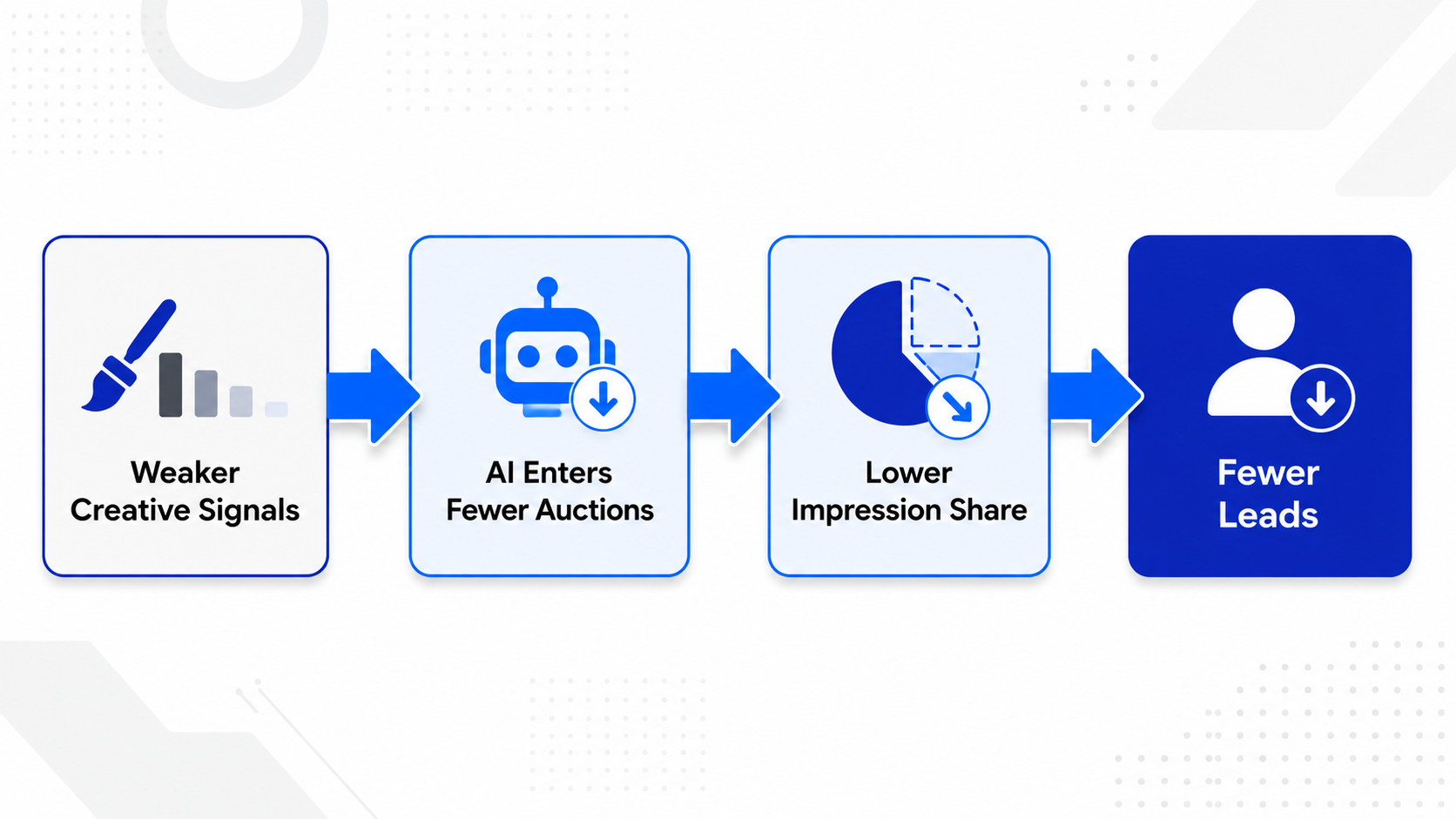
AI Overviews now appear in an estimated 15 to 20% of all search queries, and that figure is rising in commercial and informational verticals. When an AI Overview sits at the top of the SERP, it squeezes the visible space for both paid and organic results. The clicks that used to flow naturally through the top ad positions are now getting partially absorbed by the AI-generated answer above them.
Here’s the real issue. Automation doesn’t remove the need for good inputs. It amplifies the consequences of bad ones. Performance Max and AI Max campaigns make thousands of decisions per day on your behalf. If the creative assets are weak, the landing page is unclear, or the conversion tracking is set up incorrectly, Google’s AI learns the wrong behaviour from day one. Your budget spreads to the wrong users, and the results feel random.
The shift to AI first advertising means the competitive advantage has moved. It’s no longer about who can manage the most keywords manually. It’s about who can give Google the cleanest, richest signals to learn from. This is exactly where Adbiliti comes in. We focus on the inputs that make automation actually work: the creative, the audience signals, the conversion setup, and the landing page. We don’t compete with Google’s AI on keyword management. We feed it well.
The Principles That Never Change (And How to Build Your Strategy Around Them)
The platform changed. Human buying behaviour did not. These four principles held before AI-first Google Ads, and they hold now, but in 2026, the account structure that supports them needs to be set up deliberately.
1. Offer clarity beats bidding power
A clear, specific offer like “Free quote for home renovation in under 48 hours” wins more clicks at a lower CPC than a generic one competing on bid alone. Google’s AI favours ads that earn clicks consistently. Offer clarity is what earns those clicks. An F&B client in Tanjong Pagar reduced their CPL by 38% in 60 days, not by spending more, but by tightening the offer on their landing page.
2. Landing page CRO outperforms higher budget
Doubling your budget on a landing page that converts at 1% gives you twice as many expensive non-conversions. Fixing the landing page to convert at 3% triples your return without changing your spend. In an AI era account, landing page quality also directly influences your ad quality signals, which affects auction eligibility.
3. Audience signals outperform keyword volume
In 2026, telling Google who your customer is matters more than telling it what words they use. Customer Match lists, remarketing audiences, and first party data give Google’s AI the context it needs to find more of the right users. An account with strong audience signals gets into more of the right auctions without needing a massive keyword list.
4. Account structure discipline enables AI to work correctly
Google’s AI learns at the campaign level. An account with too many campaigns splitting the same budget gives each one too little data to learn effectively. Clean structure means fewer, larger campaigns with clear conversion goals. This lets the AI accumulate signal faster and make better decisions sooner.
What to Look for in a Google Ads Agency in Singapore in 2026
Most agencies in Singapore offer Google Ads management. Far fewer are structured to handle AI-first campaigns correctly. These five criteria separate the ones that can from the ones that cannot.
1. Explains AI campaign logic, not hides it
They start with one well-structured campaign based on clear objectives, test systematically with hypotheses, and can explain the strategic logic behind every decision. They use data to iterate intelligently, not hope to get lucky.
2. Reports on business outcomes, not vanity metrics
Clicks and impressions are inputs. Leads, revenue, and cost-per-acquisition are outputs. The right agency tracks what moves your business, not what makes a dashboard look active.
3. Has Singapore-specific case results
SG CPCs are not the same as US benchmarks. Verticals like F&B, med-aesthetic, and professional services have local competitive dynamics. An agency with SG results has priced, structured, and optimised inside those dynamics.
4. Google certified
Certification means the team has passed Google’s platform assessments. It does not guarantee results, but it is a baseline signal that they understand how the platform works, not just how to log in.
5. Builds an account you own, not one they lock
Your Google Ads account, your billing, your data. An agency that insists on owning your account or restricts your access to your own reports is protecting their position, not yours.
Want to see how Adbiliti measures up against these criteria? Read about our approach at adbiliti.com/about-us/
Most agencies in Singapore offer Google Ads management. Far fewer are structured to handle AI-first campaigns correctly. These five criteria separate the ones that can from the ones that cannot.
How Adbiliti Builds Google Ads Accounts That Perform Without the Guesswork
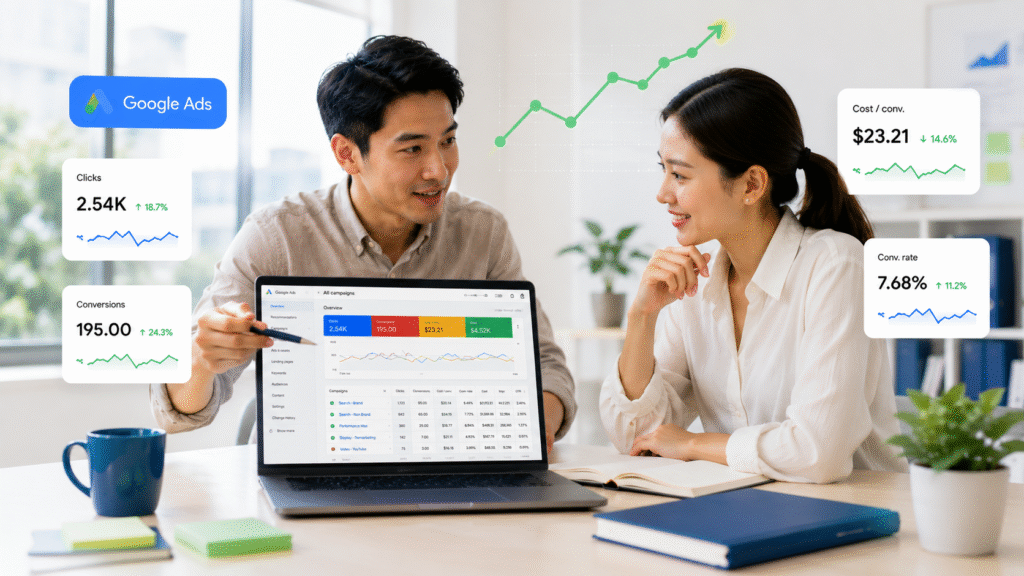
We specialise in Google Ads for Singapore SMEs. Not as one service among many, but as the only thing we do. That focus means we’ve built and audited enough accounts in this market to know what the common failure points look like, what they cost, and how to fix them.
Our approach follows three steps. We call it the Autopilot Account Architecture.
STEP 1
Diagnose
We audit your existing account or build a clean baseline if you’re starting fresh. We identify where budget is leaking, which signals are weak, and what the account structure is teaching Google to do. This takes one account review, not weeks of “onboarding”.
STEP 2
Architect
We build the account structure to match how Google’s AI actually learns. Clean campaign separation. The right conversion actions in the right priority. Audience signals connected. Asset quality reviewed. The architecture is what determines whether the AI works for you or against you.
STEP 3
Optimise
Once the structure is right, optimisation becomes systematic rather than reactive. We review signals, creative performance, and audience data on a regular cycle. The account does not need constant intervention — it needs the right checks at the right intervals.
We are a certified Google Partner agency, and we manage over half a million annual in Singapore ad spend across retail, F&B, professional services, and med-aesthetic verticals. Our accounts are built to run cleanly over time between reviews — not to require constant manual adjustment to stay functional.
You can explore our Google Ads managed service, start with a strategy call, or go straight to a free account audit if you want us to review your live account.
Frequently Asked Questions About Google Ads in Singapore
There is no fixed minimum. Most SME accounts in Singapore run between S$500 and S$10,000 per month in ad spend, depending on the vertical and the competitive intensity of the target keywords. F&B and retail can be viable at the lower end. Legal, medical, and financial services typically require higher budgets to compete effectively. The more useful question is not how much it costs, but what return it generates. A S$2,000/month account producing 20 qualified leads at S$100 CPL is more useful than a S$5,000/month account producing 15 leads at S$333 CPL. ROI is the measure, not spend.
Yes — with the right account structure. The concern most SME owners have is that AI-driven campaigns make Google Ads less controllable and therefore less reliable. That is true for poorly structured accounts. A well-built account — clear campaign architecture, strong conversion tracking, quality creative assets, and the right landing pages — gives Google’s AI the signals it needs to find the right users efficiently. The platform has become more powerful, not less. What changed is that the quality of the setup now determines the result more directly than before.
Expect a 4 to 8 week learning period for AI-driven campaigns. Performance Max and Smart Bidding strategies require a minimum number of conversions before the algorithm can optimise reliably — typically 30 to 50 conversions per campaign per month. During this window, results will be variable. This is not a sign that the campaign is failing. It is the platform calibrating. Trying to make significant changes during the learning phase resets the clock and prolongs the uncertainty. Set up the account correctly from the start, monitor without over-adjusting, and the learning phase resolves faster.
Self-management is viable for micro budgets — under S$1,000/month — where the account is simple and the time investment is manageable. Beyond that, the complexity of AI-era campaign management, the ongoing creative and audience work required, and the cost of structural errors in a live account make specialist management more cost-effective than it looks. At roughly S$2,000/month in ad spend and above, a good agency will typically recover their fee through efficiency improvements within the first 60 to 90 days. The key is choosing an agency that reports on business outcomes, not platform activity. You can start with a free audit to see what the gap looks like in your specific account.

Get Your Free Google Ads Account Audit
In 30 minutes, we will show you exactly where your budget is leaking and how to fix it.
Related Post
Walk away with clarity, not a sales pitch.
In 30 minutes, we’ll help you understand what’s working, what’s wasting budget, and what your next move should be. Free, honest, no strings attached.