
Table of Contents

Before you decide how much to spend on Google Ads, there is a question worth asking: how many people are actually searching for what you sell?
Most SMEs set their Google Ads budget based on what they can afford, what a competitor seems to be spending, or what a previous agency recommended. Very few start by measuring the actual demand for their product or service in Singapore. That is the gap this article addresses. Brand search volume — the data that tells you exactly how many people are looking for your category every month — is one of the most useful business intelligence tools you have access to, and it is built into Google’s free platform.
By the end of this article, you will know how to read Google’s own data to size your market, identify what you are missing, and make a more informed budget decision. If you want us to run this analysis on your category directly, you can book a free Strategy Call here.
Table of Contents
ToggleWhat Is Search Volume — and Why It's Not Just a Marketing Metric
Search volume is the number of times a specific phrase is searched on Google per month. Most people encounter this number inside an SEO tool or a keyword planning spreadsheet, and think of it as a measure of how competitive a keyword is.
But guess what? That framing is too narrow. Search volume is demand data. It tells you how many people in a given market are actively looking for something you sell. It is the digital equivalent of foot traffic data for a physical store. If 5,000 people walk past your shopfront each month, you can size your opportunity, plan your staffing, and set realistic revenue targets. Search volume does the same thing online.
A Singapore accountancy firm that discovers 2,400 monthly searches for “tax filing Singapore” has just measured the size of their addressable digital market for that service. That is not a keyword to target. That is a market to understand. Knowing this number before setting a Google Ads budget changes the entire conversation — from “how much should we spend?” to “how much of this market are we currently capturing, and how much more is available?”
The Difference Between Branded and Non-Branded Search (And Why It Matters for Your Budget)
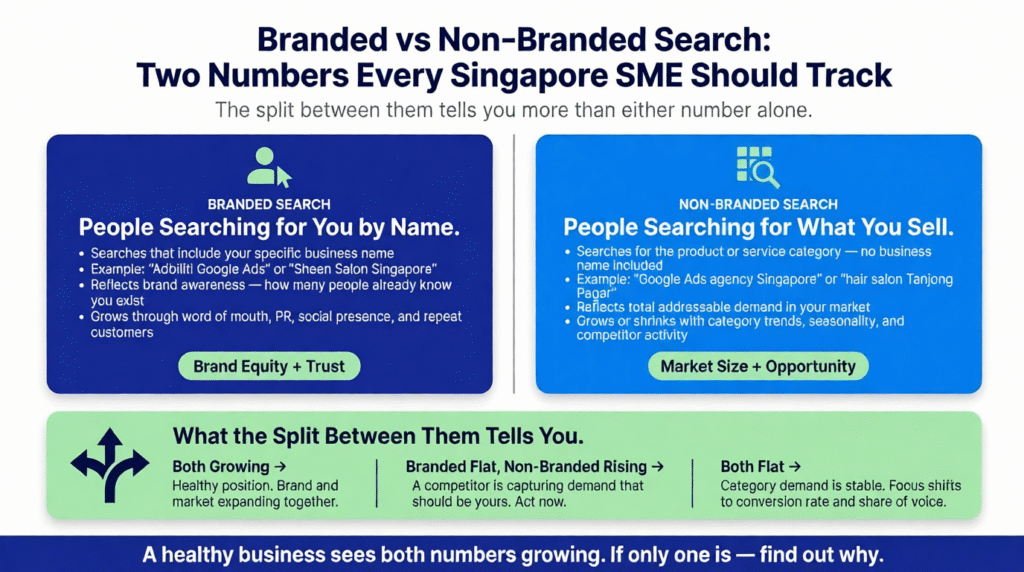
Not all search volume is the same. The most useful distinction for a business owner is between branded and non-branded search.
Non-branded search volume is the total demand in your category — people searching for the type of product or service you provide, without naming a specific business. This is your market size. Branded search volume is the number of people searching specifically for your business by name. This reflects your brand awareness and the trust you have built in the market.
A healthy business should see both growing over time. Here is where the strategic insight lies: if your branded search is flat while non-branded search in your category is rising, a competitor is capturing the demand you should own. They are growing market share. Your account may be running, your budget may be spending, but the business is not growing with the market. This is why the numbers look good but feel wrong.
Branded Search | Non-Branded Search | What the Split Tells You |
People searching for your business by name | People searching for the category you operate in | The ratio between them |
e.g. “Adbiliti Google Ads” | e.g. “Google Ads agency Singapore” | If branded is flat while non-branded grows, a competitor is taking demand you should own |
Reflects brand awareness and trust | Reflects total addressable market | A healthy business sees both growing over time |
How to Use Google Ads Data to Map Your Addressable Market
This is a three-step process you can run yourself using free Google tools. It takes under an hour for most businesses, and it will tell you more about your market opportunity than a month of campaign reports.
Step 1 — Map Total Demand
Open Google Keyword Planner and search for your core category terms, filtered to Singapore. Note the monthly search volume for each phrase. This is the size of your addressable digital market — not a guess,but a number.
Example: “corporate catering singapore” — 1,300 searches/month
Step 2 — Model Your Capture Rate
Apply a realistic click-through rate (CTR) based on your expected ad position. Position 1 typically earns 7 to 10% CTR in competitive SG verticals. Position 2 to 3 typically earns 4 to 6%. Multiply monthly volume by your estimated CTR to get potential monthly visitors.
Example: 1,300 × 5% CTR = 65 potential visitors per month
Step 3 — Identify the Gap
Compare your modelled potential against what your account is actually delivering. If your account is generating 12 clicks per month on that same category, you are capturing 18% of available demand. The other 82% is going to a competitor — or being left entirely uncontested.
Example: 12 actual clicks ÷ 65 possible = 18% captured. 82% available.
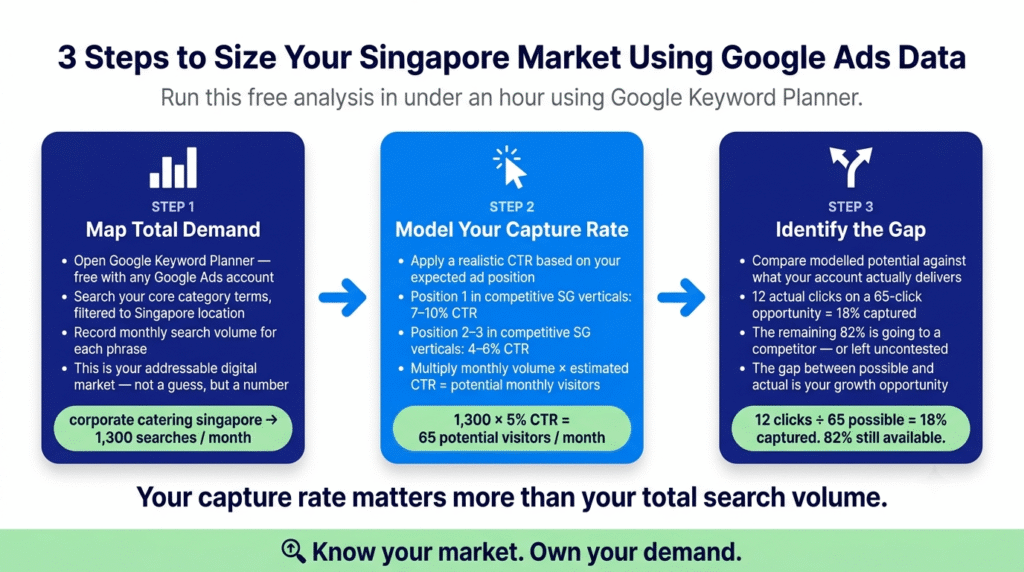
The key number to take from this exercise is not your total search volume. It is your capture rate. A category with 500 monthly searches where you are capturing 60% is a healthier position than a category with 5,000 monthly searches where you are capturing 2%. Market size only matters in proportion to how much of it you are currently reaching.
How Seasonal Search Trends Affect Your Budget Planning
Search volume is not static. Most Singapore verticals follow predictable seasonal patterns that should directly influence how you allocate your monthly ad budget. Use Google Trends alongside Google Keyword Planner to see how demand fluctuates across the year.
F&B and retail categories peak around Chinese New Year and Deepavali. Accountancy and corporate services spike at the end of the financial year and during the March to April tax filing window. Education verticals see sharp demand rises around school registration and examination periods. Professional services tied to business registration or HR software often see a January surge as new financial years begin.
The practical implication is straightforward: a flat monthly budget means you are underspending during peak demand and overspending during quiet periods. Aligning your budget to the demand curve — spending more when more people are searching, and pulling back when they are not — This is one of the simplest ways to improve cost efficiency without changing anything else in the account.
What a Smart Google Ads Agency Does With This Data Before Spending a Single Dollar
There is a clear difference between an agency that takes a brief and launches a campaign, and one that starts by understanding the market the campaign is entering. The first asks: what is your budget? The second asks: what is your addressable market?
Agencies that do this well run a demand audit before campaign launch. They map the total monthly search volume in the client’s core category, broken down by Singapore location. They identify the branded versus non-branded split to understand how much of the demand is category-level versus brand-specific. And they flag seasonal patterns in the data so the budget plan matches the demand curve rather than running at a fixed rate regardless of what the market is doing.
This work takes a few hours. It changes the entire structure of the campaign that follows. An account built on accurate market demand data sets realistic targets, allocates budget proportionately across sub-categories.
When we ran a demand audit for a Singapore Home Furnishing, we found three times more search demand in their one vertical than in 8 other related product category. We shifted budget toward the product with the highest demand, while pausing the campaigns that promoted the other 8 products. Results moved in the business — not just in the dashboard. This is how we approach every new client engagement at Adbiliti.
How Adbiliti Uses Search Volume to Build Smarter Google Ads Accounts

Before any campaign goes live at Adbiliti, we run a Market Demand Audit. It is not a deliverable we charge separately for. It is the foundation every account is built on.
The audit covers four things. First, we map total search demand in the client’s category, filtered to Singapore location, broken down by sub-service and intent. Second, we identify the branded versus non-branded opportunity split — how much of the available demand is category-level, and how much is already brand-driven. Third, we model realistic capture rates at various budget levels, so the client has a clear picture of what each dollar of spend could return at different positions. Fourth, if prior conversion data is available, we model potential conversions against search demand, budget, and bid dynamics to determine the maximum opportunity for the various products and solutions.
A professional services client in Singapore discovered through this audit that 40% of the search demand in their category was concentrated in a sub-service they were not advertising at all. We shifted 30% of their budget toward that sub-service. CPL dropped by 27% in 8 weeks. The demand was already there. It just had not been found. You can see the full approach in our Google Ads managed service, or start with the Google Ads Audit if you want us to run the demand analysis on your live account.
Want to see what demand exists for your business in Singapore? Book a free Market Demand Snapshot at Adbiliti
Frequently Asked Questions About Search Volume and Google Ads Strategy
Brand search volume is the number of times people search for your specific business name on Google each month. It reflects brand awareness — how many potential customers already know you exist and are actively looking for you by name. A growing brand search volume signals that your marketing efforts are building recognition. A flat or declining brand search volume, while non-branded searches in your category are rising, means competitors are capturing demand that your business should be earning. Tracking both gives you a clearer picture of your competitive position than conversion data alone.
The most reliable free tool is Google Keyword Planner, which requires a Google Ads account to access. Search for your core category terms and filter the location to Singapore to see monthly search volumes specific to your market. Google Trends is a useful complement for understanding relative demand shifts over time and identifying seasonal peaks in your vertical. If you want a full demand analysis with competitor context included, Adbiliti can run this as part of a free audit.
There is no universal threshold. A category with 500 monthly searches in Singapore can be highly profitable if the conversion value is high and the competition is limited. A category with 10,000 monthly searches can be expensive and inefficient if the intent is too broad and the competition drives CPCs to unworkable levels. The more useful question is not the total volume but your current capture rate. If you are only reaching 10% of the available demand in a category, the opportunity is not whether to advertise — it is how to improve your position within the existing demand pool. Even modest search volume categories can deliver strong ROI with the right conversion funnel behind them.
Yes — and that is the right question to ask before engaging any agency. A strategic agency treats keyword search volume as market intelligence, not just as a campaign input. At Adbiliti, our onboarding process includes a Market Demand Audit before any campaign goes live. We map total category demand in Singapore, identify your branded versus non-branded opportunity split, and model realistic capture rates at your budget level. This work sets the foundation for a campaign that is sized to the actual market — not to a recycled playbook. You can start with a free audit here or explore our Google Ads strategy approach to see how we structure engagements from the ground up.
Get Your Free Market Demand Snapshot
In 30 minutes, we will show you exactly how much demand exists for your business in Singapore, how much you are currently capturing, and where your competitors are winning.
No spreadsheets. Just clarity.
Prefer a strategy call first? Reach us here

Get Your Free Google Ads Account Audit
In 30 minutes, we will show you exactly where your budget is leaking and how to fix it.
Related Post





Walk away with clarity, not a sales pitch.
In 30 minutes, we’ll help you understand what’s working, what’s wasting budget, and what your next move should be. Free, honest, no strings attached.