
Table of Contents
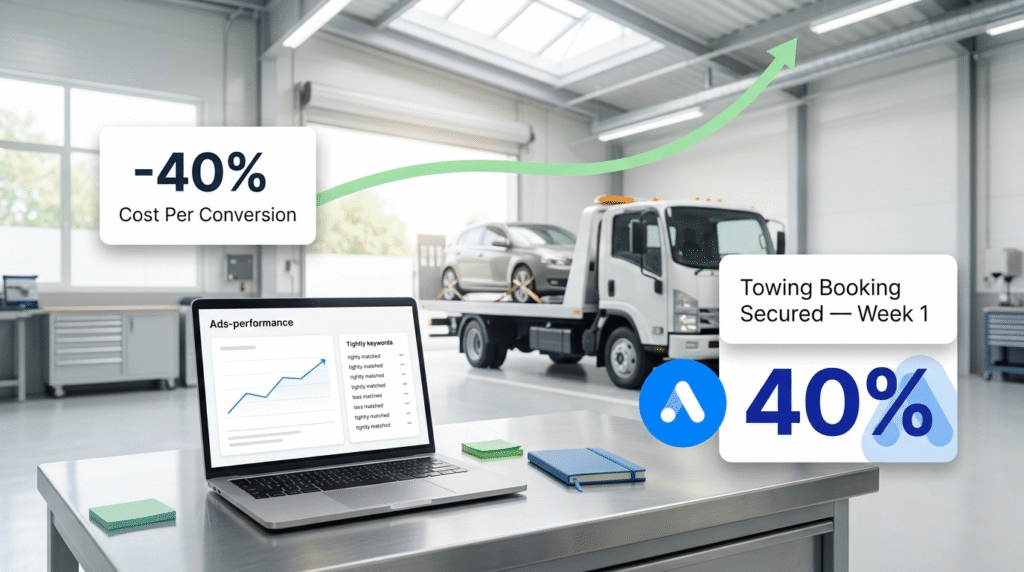
Table of Contents
ToggleBackground: A Multi-Service Automotive Expert
My Car Consultant is a comprehensive automotive provider in Singapore, offering car repair services and emergency towing under one roof. Founded by Jeremy, the business depends on being found at exactly the right moment, whether a driver is booking scheduled maintenance or stranded on the PIE at midnight.
The business had presence and credibility. What it lacked was a reliable digital marketing system that could turn online searches into real bookings consistently, not just on a good week, but every week.
Jeremy had already tried two routes before coming to Adbiliti. He had attempted to manage his own ads, and he had hired agencies. Neither delivered what the business actually needed.
The Challenge: Clicks Without Bookings
My Car Consultant faced a problem that many automotive businesses in Singapore will recognise: plenty of clicks, but very few actual bookings. The numbers in the dashboard looked reasonable. The booking calendar told a different story.
Here’s the real issue. Jeremy had started his Google Ads account the way most first-time advertisers do, through Google’s own guided setup, which defaults to Smart campaigns. Smart campaigns hand almost all control over to Google’s automation. You set a budget, write a few lines of ad copy, and Google decides who to show it to. The problem is that Smart campaigns behave similarly to Performance Max, where bidding decisions are largely opaque and the advertiser has very little say over which search terms trigger the ads.
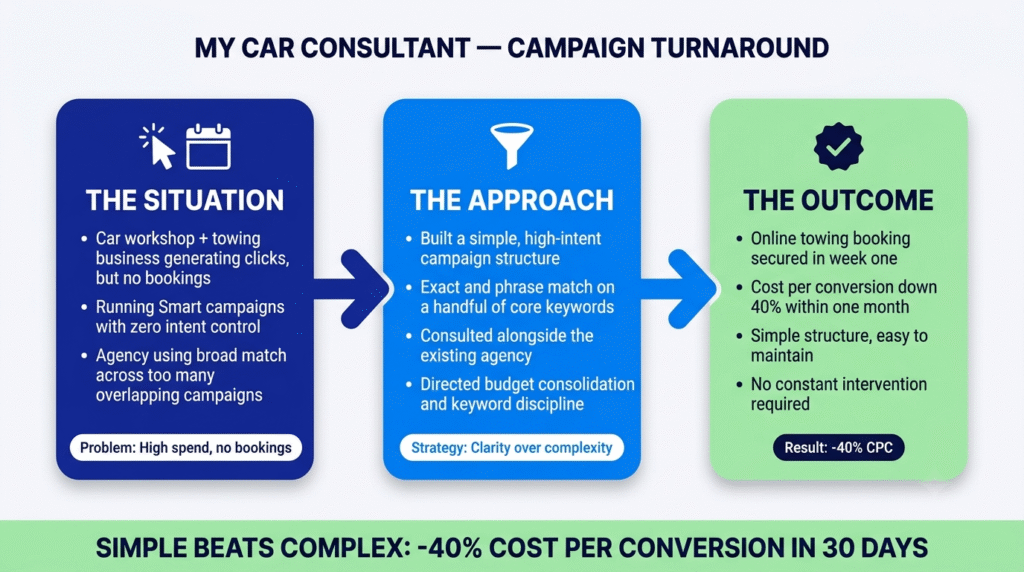
The agency that followed did not improve things much. They were bidding on a large number of keywords across multiple campaigns, using broad match types that allowed Google to interpret the intent loosely. An ad for “car repair services” could appear for someone searching for “DIY car maintenance” videos. A towing ad could show up for someone shopping for toy tow trucks. Google was learning the wrong thing, and no one was correcting it.
When you have too many campaigns running with overlapping keywords and broad match types, the budget spreads to the wrong users. Reporting becomes confusing, cost per lead stays artificially high, and the business cannot tell what is working and what is not. This is why the numbers look good but feel wrong when you check the actual booking calendar.
The Approach: Consolidation and High Intent
We did not want to add more campaigns to an already cluttered account. Fix this first was the operating principle. The goal was to simplify how Google understood My Car Consultant’s services, and to give the algorithm a clear, tight signal to work with.
The first observation was that the core keywords for this business, terms like “car workshop Singapore”, “car repair Singapore”, and “tow truck Singapore”, already carry significant search volume on their own. You do not need dozens of keyword variations to capture that demand. You need to ensure that when someone searches those terms with genuine intent, your ad appears. Exact match and phrase match types gave us that control, keeping the search terms tight and the traffic relevant, without restricting reach unnecessarily.
Jeremy also had another agency on retainer at the time. Rather than replacing them entirely, we worked alongside them as a consultant, providing specific direction on campaign structure, budget allocation, and keyword discipline. The goal was to fix the signals, not to create another layer of complexity.
Execution
- Replaced Smart campaigns with standard Search campaigns, restoring control over which keywords triggered the ads and at what match type
- Built a simple campaign structure targeting a small set of high-intent, high-volume keywords for each service: workshop and towing kept separate
- Directed the agency to consolidate fragmented campaigns and remove broad match keywords that were generating irrelevant traffic
- Ran the new structure in parallel with the existing agency setup, monitoring performance and adjusting based on actual booking data
Let’s break this down. A complicated campaign structure does not produce better results. It produces more maintenance, more breaking points, and more confusion about what is actually driving the outcomes. Every additional campaign, ad group, or keyword variation is another variable that needs to be monitored and managed. More moving parts means more places for things to go wrong quietly.
Agencies sometimes build complex structures because complexity looks like effort. It signals that work is being done. A setup with fifteen campaigns and hundreds of keywords can appear thorough on a monthly report, even if the actual results are poor. The simpler approach we took here, a handful of tightly controlled keywords in a clean structure, was less visually impressive but far more effective. You see this when your cost per click stays roughly the same but your conversion rate suddenly improves because the traffic reaching your landing page is genuinely looking for what you offer.
The Results: Bookings in Week One
The impact of moving to a clarity-first structure was almost immediate. Within the first week of running the new campaigns, My Car Consultant received an online booking for a towing job. This was something the previous agency had not been able to produce in months of managing the account.
Within one month, cost per conversion had dropped by 40%. The budget had not increased. The account had simply been given clearer signals to work with, and the algorithm responded accordingly.
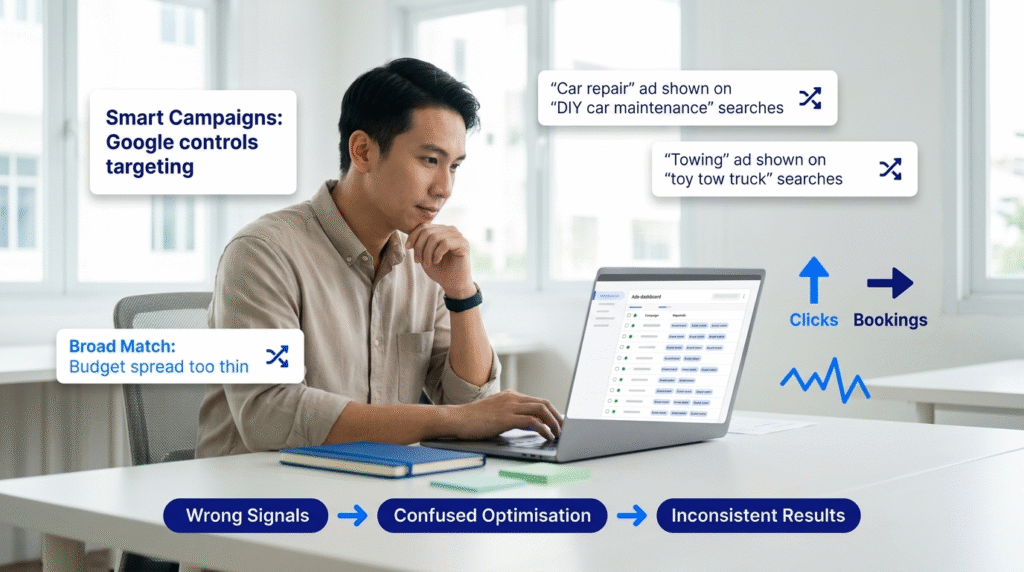
| Phase | Description |
|---|---|
Situation |
A car workshop and towing business generating clicks but no bookings, running Smart campaigns with no intent control and an agency using broad match across too many campaigns. |
Approach |
Built a simple, high-intent structure using exact and phrase match on a handful of core keywords. Acted as a consultant alongside the existing agency to direct budget consolidation and keyword discipline. |
Outcome |
Online towing booking secured in the first week. Cost per conversion reduced by 40% within one month. Simple structure that is easy to maintain and does not require constant intervention. |
My Car Consultant now has a campaign structure that is easy to maintain and does not require constant intervention to stay effective. A small number of well-chosen keywords, tightly matched to real buyer intent, continues to generate bookings without the overhead of a complex account that nobody fully understands.
“We’d tried multiple agencies before, but none delivered consistent results. Xuan Bin built a simple, scalable structure focused on high-intent keywords and worked alongside our existing agency to refine strategy. Within a week, we had bookings coming in — and a 40% drop in cost per lead.”
— Jeremy, Founder, My Car Consultant
What a Simple Structure Actually Delivers
Bookings From Week One
After months of clicks that did not convert, My Car Consultant received a towing booking in the first week of running the new structure. The change was not a bigger budget or a more aggressive bid strategy. It was cleaner targeting that put the ad in front of people with genuine and immediate intent.
40% Reduction in Cost Per Conversion
Within one month, cost per conversion dropped by 40%. The budget stayed the same. The difference was that Google was no longer wasting spend on low-intent or irrelevant searches because the match types and keyword selection no longer allowed it to.
A Structure That Is Easy to Maintain
The final campaign structure was built on a handful of high-intent keywords rather than hundreds of variations. That simplicity is not a compromise. It is the point. A setup with fewer moving parts is easier to monitor, easier to optimise, and much harder to break quietly without anyone noticing.
Parallel Progress Without Disruption
Because the new structure ran alongside the existing agency rather than replacing them entirely, My Car Consultant was able to see the difference in results directly, without creating operational disruption. The comparison spoke for itself.
How Adbiliti Helps
If your current digital marketing feels like a black box where budget goes in but bookings do not come out, you likely have a structure problem. Most agencies add campaigns when results are poor. We look at whether the existing structure is sending Google the right signals in the first place.
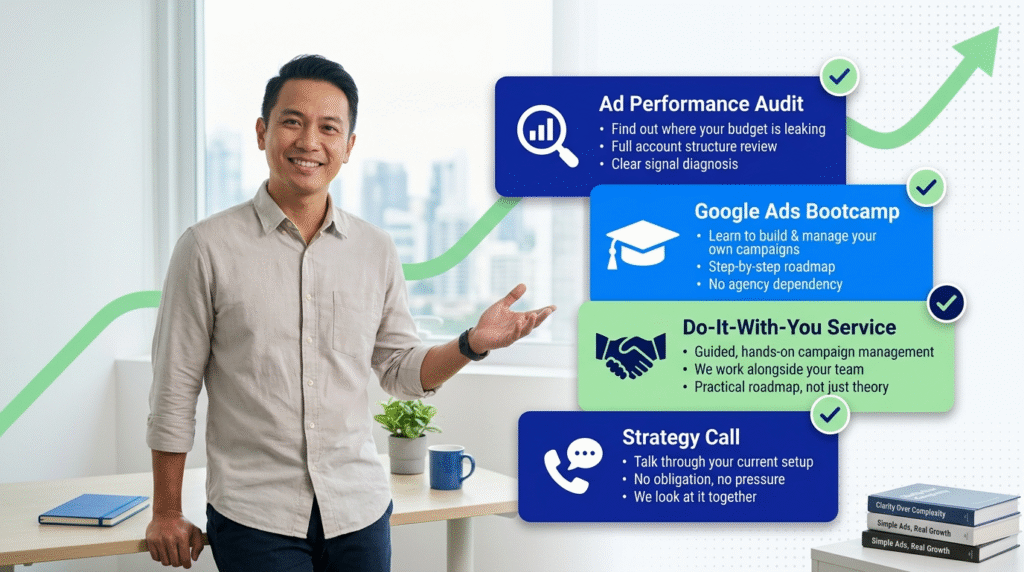
We do not believe in complex setups that only a consultant can understand or maintain. Simple structures with clear signals produce better results and are far easier to manage long-term.
If you want to find out where your budget is leaking, start with an Ad performance audit. If you want to learn how to build and manage this yourself, our Bootcamp or do-it-with-you service provides the roadmap. Or if you want to talk through your current setup first, book a strategy call and we can look at it together.
Google Ads FAQ for SMEs (My Car Consultant Case Study)
This is the most common complaint from automotive businesses running Google Ads in Singapore, and it almost always comes down to a mismatch between who your ads are reaching and who is genuinely ready to book. When campaigns are too broadly structured with loose match types or Smart campaign automation, Google’s algorithm starts showing your ads to people who are casually browsing rather than actively looking for help. Someone researching car maintenance at home is not the same as someone whose car has broken down on the CTE and urgently needs a tow. The fix is to use exact and phrase match keywords that reflect genuine, immediate need: terms like tow truck Singapore urgent, car breakdown help now, car workshop open Sunday Singapore. The more tightly your keywords match real buying intent, the higher your chance of turning a click into an actual booking.
Yes, for most SMEs it is. Smart campaigns hand almost all bidding and targeting decisions to Google’s automation, which sounds convenient but means you have very little control over which search terms trigger your ads or what kind of user sees them. The result is often similar to Performance Max, where the algorithm optimises toward signals that may not reflect real buyer intent. If you are not tracking conversions properly, which is common for accounts set up through the Smart campaign flow, Google has no way of knowing what a good outcome looks like, and it will optimise toward clicks rather than bookings. Switching to a standard Search campaign with manual or target CPA bidding, proper conversion tracking, and tightly controlled keywords gives you back control over the signals you are sending Google.
Campaign consolidation means taking too many small, overlapping campaigns and combining them into fewer, better-funded ones. Many agencies and business owners create a separate campaign for every service or keyword variation and end up with ten or fifteen campaigns each receiving a small daily budget. The problem is that Google’s Smart Bidding algorithm needs a meaningful amount of conversion data to understand who your best customers are and optimise toward them. When the budget is split too thinly, no single campaign ever reaches that threshold, and they all underperform. By consolidating into two or three well-structured campaigns with sufficient budget, you give the algorithm the data it needs to improve, and you often see better results without spending a single dollar more. Fewer campaigns also means fewer things to monitor and fewer places for problems to develop unnoticed.
Keep them in separate campaigns, because the people searching for each service have completely different levels of urgency. Someone searching for car servicing Singapore is planning ahead and comparing options. Someone searching for tow truck Singapore now needs help within the hour. These two audiences require different bids, different ad copy, different budget levels, and different landing pages. Build one campaign focused entirely on workshop and servicing keywords, and a completely separate campaign for towing and emergency keywords. Within each campaign, keep the keyword list short and tightly matched. The core intent terms for each service already carry enough search volume on their own. You do not need hundreds of variations to capture that demand.
Ask for direct access to your Google Ads account, not just a monthly PDF report, and look for a few telling signs. Check whether there are too many campaigns running with overlapping keywords, which splits the budget and sends mixed signals to Google. Look at your Search Terms Report: if it is full of irrelevant searches and no negative keywords are being added regularly, the account is not being actively managed. Compare the conversions Google Ads is reporting against the actual bookings and calls you received. If the numbers do not match, your tracking is broken. Also consider whether the complexity of the account structure actually reflects the complexity of your business, or whether it has been built to look like a lot of work is being done. A good structure for most SMEs is simple, not elaborate. If your agency cannot explain why each campaign exists and what it is designed to do, that is a warning sign.
Negative keywords are search terms you specifically tell Google not to show your ads for. They are one of the most powerful tools in Google Ads and one of the most neglected. Without a good negative keyword list, your towing ad might appear for someone searching toy tow truck for kids, or your workshop ad might show up for car mechanic jobs Singapore. None of these searches will ever turn into a booking, but you will still pay for every click. Build your negative keyword list before you launch by thinking through every irrelevant variation of your service keywords. Then review your Search Terms Report every fortnight to catch new irrelevant queries and add them. A well-maintained negative keyword list cuts wasted spend without reducing your reach to the customers who actually matter.
Claim Your Google Ads Audit (Free) Enter your website and we will show you your current stats, what’s draining it, and fix steps. Rated 4.9/5 by 60+ SME owners |

Get Your Free Google Ads Account Audit
In 30 minutes, we will show you exactly where your budget is leaking and how to fix it.
Related Post





Walk away with clarity, not a sales pitch.
In 30 minutes, we’ll help you understand what’s working, what’s wasting budget, and what your next move should be. Free, honest, no strings attached.