
Table of Contents
Table of Contents
ToggleBackground: A Premium Standard for Fresh Fruit Baskets
The First Fruits is a well-regarded provider of premium fresh fruit baskets and gift boxes in Singapore. Founded by Benjamin Foo, the business has built a reputation for quality and presentation across its range of omakase-style fruit gift boxes and curated gifting collections.
As an e-commerce business operating in a competitive gifting market, The First Fruits needed Google Ads to perform throughout the year and spike predictably during peak seasons like Chinese New Year, Valentine’s Day, Mother’s Day, Hari Raya and Christmas. What the account showed and what the business actually experienced were two very different things.
The Challenge: The Cost of Trusting the Wrong Numbers
Before engaging Adbiliti, The First Fruits had been managing its own Google Ads. The campaigns were running. The dashboard was reporting conversions. The ROAS looked acceptable. But the actual revenue impact was inconsistent and hard to explain.
The real issue was the conversion tracking itself. It was broken, and nobody noticed because the reports still looked believable.
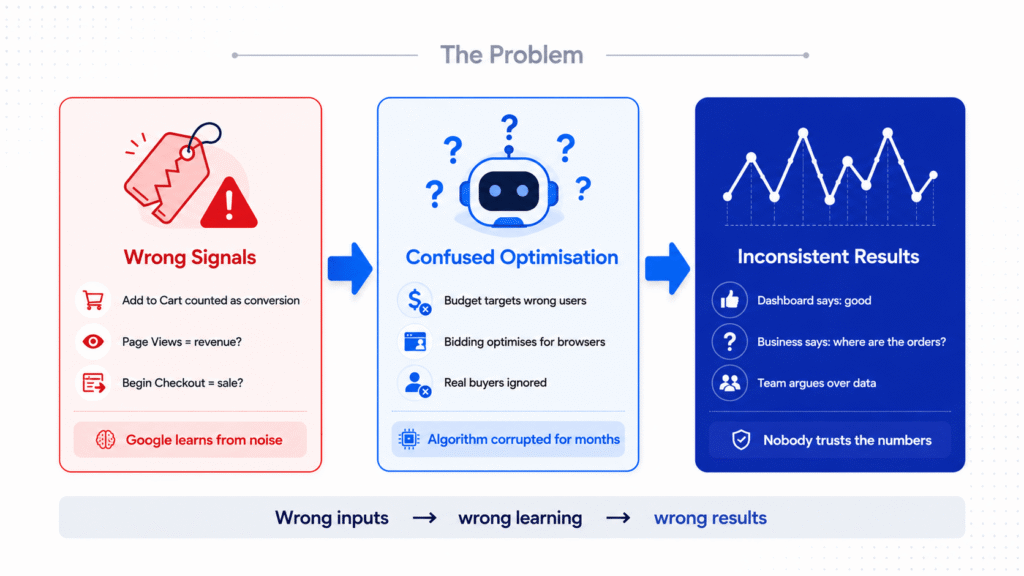
False Conversions Were Inflating Every Metric
The account was tracking secondary events as primary conversion actions. Add to Cart, Begin Checkout, View Item, and page views were all being counted alongside actual purchases and rolled up into a single conversion total. On the surface, the Performance Max campaign appeared to be generating thousands of dollars in conversion value. In reality, most of that figure came from users who had added something to a cart and left, or simply viewed a product page.
The only number that mattered was completed purchases. Everything else was noise. But because Google’s algorithm was optimising toward all of those events equally, it was spending budget to find users who would browse and tap Add to Cart, not users who would actually buy. Google was learning the wrong thing, and the training data had been corrupted for months before the account was reviewed.
This is why the numbers look good but feel wrong when you check the actual order volume. Reporting becomes confusing, teams argue over what the data means, and eventually, nobody trusts the dashboard because the dashboard and the business are telling completely different stories.
Then… the Automation Made It Worse
In October 2023, Google’s auto-apply recommendations feature switched the campaign’s bidding strategy from Maximise Conversions to Target ROAS, and set the target at 1,498%. That means Google was instructed to generate $15 in revenue for every $1 spent, despite the fact that the highest ROAS the account had ever actually achieved was 600%.
The result was immediate and severe. Conversion value dropped by 85% on the day the change was implemented. The campaign effectively stopped finding buyers because the target it was given was so far from anything it had seen before that it restricted its own reach to near zero.
This is the risk of leaving auto-apply recommendations enabled when the account’s underlying data is not clean. The AI made a confident decision using unreliable inputs, and the business paid for it directly.
The Approach: Three Phases, Done in Order
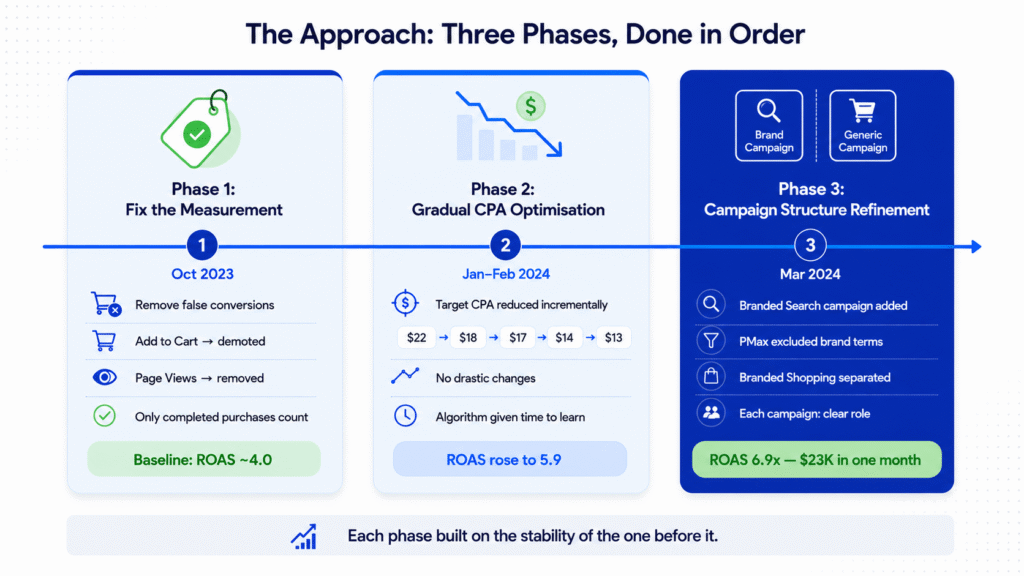
The recovery was not a single fix. It was a structured sequence of interventions, each one building on the stability created by the one before it. Rushing any phase would have introduced new instability before the previous problem was fully resolved.
Phase 1
We Fix the Measurement First (October 2023)
The first step was to remove every secondary conversion action from the primary conversion column, which is: Add to Cart, Begin Checkout, View Item, and page views were all demoted or removed entirely. The only event that counted as a conversion going forward was a completed purchase.
This reset the ROAS to an accurate baseline. The number dropped on paper, but it was now a real number. The algorithm could finally see what was actually happening in the business rather than what the previous tracking had been telling it. We fix this first. Without clean data, every other decision compounds the error.
Phase 2
Gradual CPA Optimisation (January to February 2024)
Once the tracking was clean and the account had gathered reliable purchase data over several weeks, we began adjusting the Target CPA incrementally. The goal was to give the algorithm a realistic target and then tighten it slowly as it demonstrated it could meet each threshold.
The CPA data tells the story clearly. Starting from approximately $22 per conversion in November 2023, the cost per sale reduced month on month: $18 in December, $17 in January, $14 in February, and $13 by March 2024. Each reduction was gradual, never more than what the account could absorb without disrupting volume. You see this when performance improves steadily rather than lurching between good weeks and silent ones.
Phase 3
Campaign Structure Refinement (March 2024)
The final phase addressed a structural problem that had been limiting the account’s efficiency throughout. The Performance Max campaign captured both branded and generic search traffic, which meant brand-name searches were treated the same as generic acquisition searches, and the budget allocation between them was invisible.
We introduced a dedicated Branded Search campaign using phrase and exact match keywords to capture users searching specifically for The First Fruits. A Branded Shopping campaign was added alongside it, set to low priority and configured to exclude non-branded terms. The Performance Max campaign was then given brand exclusions so it would focus entirely on generic acquisition without competing for traffic that the branded campaigns were already winning.
This structure gave the business full visibility into where brand demand was coming from, how much it cost, and how it converted relative to generic traffic. Budget control improved significantly because each campaign type had a clear and distinct role.
| Phase | What Was Done | Impact |
|---|---|---|
Phase 1 — Oct 2023 |
Removed false conversions (Add to Cart, page views). Focused tracking exclusively on completed purchases |
Removed false conversions (Add to Cart, page views). Focused tracking exclusively on completed purchases. |
Phase 2 — Jan–Feb 2024 |
Gradual Target CPA reductions. Avoided drastic changes that shock the algorithm. |
CPA dropped month-on-month: $22 → $18 → $17 → $14 → $13. ROAS rose progressively to 5.9. |
Phase 3 — Mar 2024 |
Added dedicated Branded Search campaign (phrase and exact match) and Branded Shopping campaign. PMax excluded brand terms. |
ROAS reached 6.9 in April 2024. Conversion value exceeded $23,000 in a single month. |
The Results: Consistent Returns on Clean Data
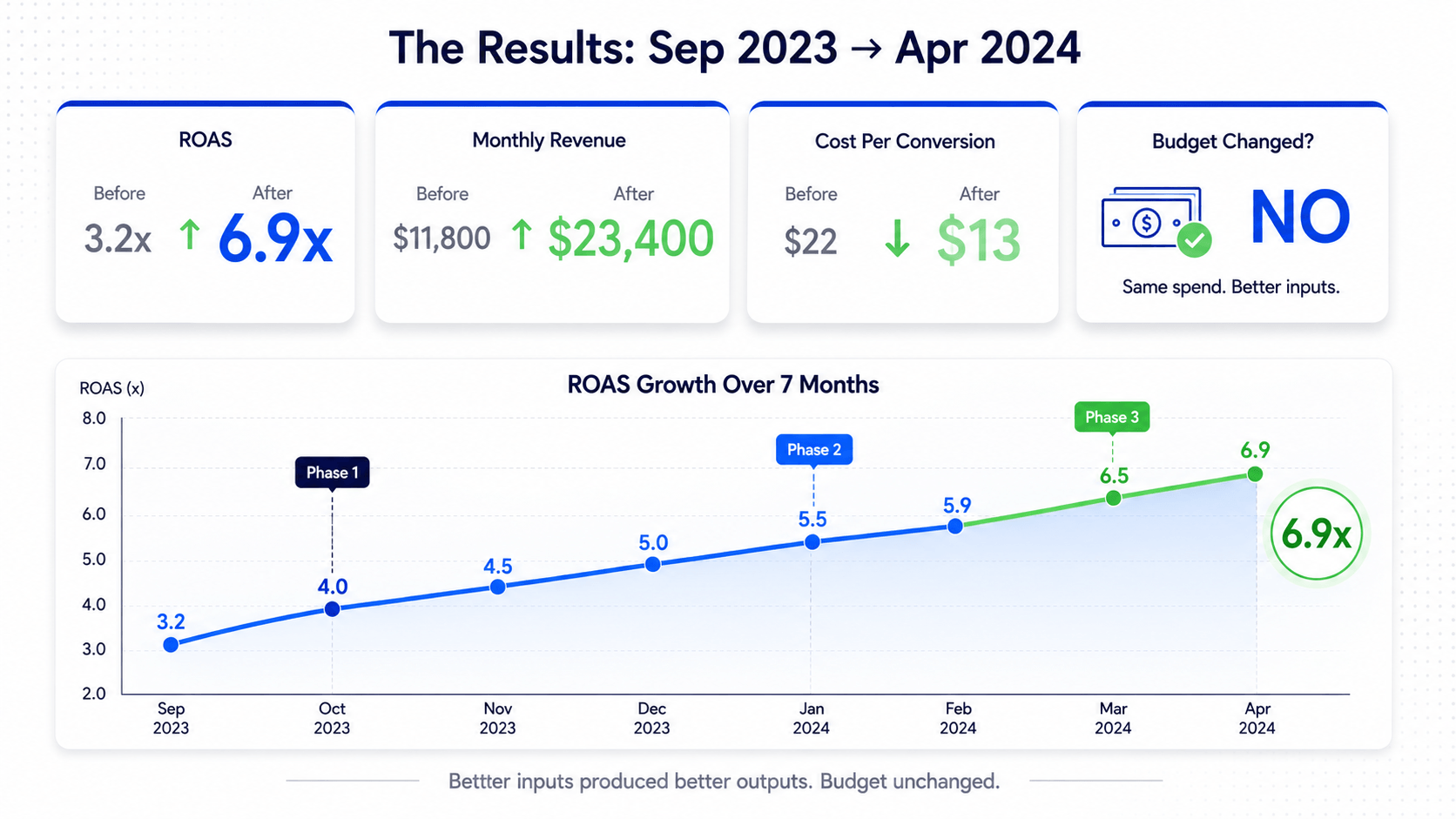
From September 2023 to April 2024, the account’s performance changed substantially. The ROAS moved from a real baseline of 3.2 to 6.9, measured accurately against completed purchases only. Monthly conversion value grew from approximately $11,800 to $23,400. The cost per conversion fell from $22 to $13.
None of this was achieved through a larger budget or more aggressive spending. The budget remained consistent throughout, and what changed was the quality of the data feeding the algorithm, the discipline of the bidding adjustments, and the clarity of the campaign structure. Better inputs produced better outputs.
| Phase | Description |
|---|---|
Situation |
An e-commerce gifting business with inflated ROAS reporting from false conversions, over-reliance on Performance Max, and an AI bidding misconfiguration that collapsed revenue by 85% in a single day. |
Approach |
Phased optimisation: fixed conversion tracking first, then adjusted CPA targets gradually, and then restructured campaigns to separate brand demand from generic acquisition. |
Outcome |
ROAS improved from a real baseline of 3.2 to 6.9 over seven months. Conversion value grew from approximately $11,800 to $23,400 per month. CPA reduced from $22 to $13. |
“After years with consultants who didn’t deliver, we finally started seeing steady enquiries again. Adbiliti focused on one service, fixed our tracking, and made sure every dollar counted. It’s simple, effective, and built on trust.”
Benjamin Foo, Founder, The First Fruits
A Note on Performance Max: When to Use It and When to Be Careful
The First Fruits case illustrates both the potential and the risks of Performance Max. When the tracking data is clean, the campaign structure is correct, and the account has sufficient purchase history, PMax can work well for an e-commerce business. The problem is that most accounts do not meet all three conditions when PMax is first switched on.
When Performance Max is likely to work well:
- You have a monthly ad budget of at least $8,000 as a starting point, giving the algorithm enough volume to learn from
- You already have a standard Search campaign running that has been generating real conversions, which will provide training data for PMax to draw from
- You sell consumer products through an e-commerce store, where purchase events can be tracked accurately
- Your conversion tracking is clean and measures completed transactions, not secondary intent signals
When to be cautious or avoid Performance Max entirely:
- You are running B2B lead generation, where conversion volumes are typically too low for the algorithm to optimise effectively
- Your conversion tracking is not yet set up, or is measuring the wrong actions
- Your monthly budget is below the threshold needed for the campaign to gather sufficient data
- You have auto-apply recommendations enabled and have not reviewed what changes it is making
The auto-apply recommendation that set a 1,498% Target ROAS in this account is a direct example of why operator oversight matters. Automation does not know your business context, your historical performance ceiling, or the seasonal patterns that affect your category. It processes the data it is given and applies rules. When the data is wrong, or when a recommendation is applied without review, the consequences can be immediate and significant.
The lesson here is not that PMax is bad. It is that PMax requires a clean foundation before it can do its job. Signal clarity before scaling applies to automation just as much as it applies to any other part of the account.
What This Case Study Demonstrates
The Only Numbers That Matter Are Real Sales
xCounting Add to Cart and page views as conversions made the account look productive while the business remained flat. The moment those secondary events were removed from the primary conversion column, the true picture became visible, and every subsequent decision improved because it was based on accurate information.
Automation Needs Accurate Inputs to Produce Accurate Outputs
Google’s AI bidding tools are genuinely powerful, but only when the data they’re fed reflects how buyers actually behave. Feed them bad data and they’ll optimise confidently toward the wrong outcome. The 1,498% Target ROAS that auto-apply pushed through in October 2023 wasn’t a rogue decision. It was a perfectly logical recommendation, just built on inflated numbers. Bad inputs, bad output. Once we fixed the inputs, the outputs fixed themselves.
Incremental Adjustments Outperform Dramatic Resets
Bringing CPA down from $22 to $13 took four months of small, deliberate changes. Trying to make that jump in one move would have shocked the algorithm and probably tanked volume. That’s exactly what happened with the 1,498% ROAS target. Gradual changes give the algorithm room to adjust without throwing away the performance it’s already built.
Campaign Structure Controls Visibility and Budget
Separating branded from generic traffic was not cosmetic. It gave the business a clear picture of how much brand demand was worth, what generic acquisition was actually costing, and where the budget should be allocated to get the best return. Before the restructure, those signals were blended and invisible. After it, each campaign type could be managed independently and measured accurately.
How Adbiliti Helps
Most e-commerce accounts are not performing as badly as they appear, or as well as the dashboard suggests. The gap between the two is almost always a tracking or structure problem. When the signals going into the algorithm are clean and the campaign architecture is clear, Google can do its job properly.
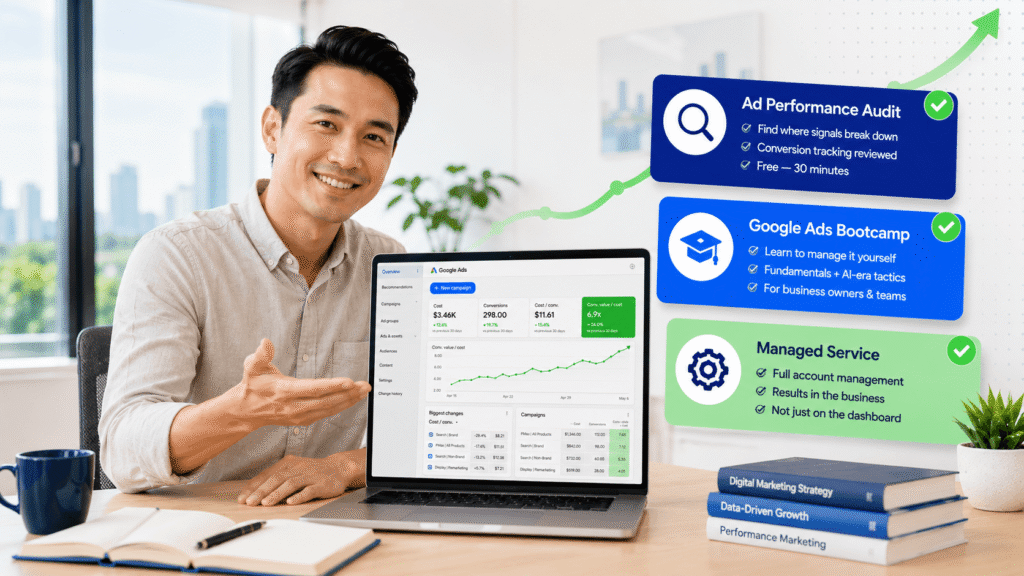
If you are running Performance Max and not sure whether your conversions reflect real sales, or if your ROAS looks strong but the revenue does not match it, we can look at the account together. Start with an Ad performance audit to find where the signals are breaking down. If you want to learn how to manage this yourself, our Bootcamp covers the fundamentals. For those who want the technical work handled from the start, our Google Ads managed service is built to move results in the business, not just on the dashboard.
The First Fruits — Google Ads FAQ for SMEs
Erratic Performance Max results almost always trace back to one of three issues. First, your conversion tracking may be measuring the wrong things. If secondary events like Add to Cart or page views are included in your primary conversion column, Google is optimising toward browsers rather than buyers, and the results will be unpredictable. Second, your ROAS or CPA target may be set too ambitiously for what the account has historically achieved. Google needs at least 30 to 50 purchases per month to optimise reliably, and if it cannot meet the target, it will cause the campaign to restrict its own reach. Third, you may have auto-apply recommendations enabled, which can change your bidding strategy without warning. Check your Change History in Google Ads regularly to see what the system has modified. The First Fruits experienced an 85% drop in conversion value in a single day because auto-apply set a Target ROAS of 1,498%, far beyond anything the account had ever achieved. The fix in each case is the same: sort the tracking first, set realistic targets, and monitor what the automation is doing.
Performance Max works well under the right conditions, but it is not the right starting point for every business. It is best suited to e-commerce businesses with a monthly ad budget of at least $8,000, clean purchase tracking in place, and an existing Search or Shopping campaign that has already been generating conversions as training data. If you meet those conditions, PMax can extend your reach and improve efficiency. If you do not, the algorithm has too little to work with and will make poor decisions confidently. For B2B lead generation, where enquiry volumes are typically too low for the algorithm to learn from, Performance Max is rarely the right choice. Start with:
- A focused Search campaign,
- Build a reliable conversion history, and
- Add PMax once the account has enough real purchase data to train on.
than before.
Work backwards from your profit margins rather than picking a number that sounds strong. Divide one by your gross profit margin as a decimal. If your gross margin is 40%, your break-even ROAS is 1 divided by 0.4, which equals 2.5. That means you need at least $2.50 in revenue for every $1 of ad spend just to cover the cost of goods, before factoring in overheads or shipping. A sensible starting target is around 20% to 30% above that break-even figure, giving Google enough room to find buyers without being so restricted that the campaign barely spends. Once performance has been stable for several weeks, you can nudge the target higher gradually. The First Fruits reached between 5x and 6.9x ROAS after the account was properly structured, but the journey started at a realistic 4.0 baseline, not an aspirational 15x target.
It is a problem if those events are included in your primary conversion column and therefore counted as conversions that Google optimises toward. Secondary events like Add to Cart, Begin Checkout, and View Item are useful for observation and reporting, but they should never sit in the primary conversion column alongside completed purchases. When they do, Google treats a user who added an item to a cart and abandoned it the same as a user who completed a purchase. The algorithm then finds more people who behave like the former rather than the latter. The fix is to demote all secondary events to observation-only status in your conversion settings, so they appear in the data for reference but do not influence bidding decisions. Only completed purchase events should drive optimisation.
Plan in three phases. In the ramp-up period, starting three to four weeks before the peak, increase your budget by 30 to 50% and ensure your campaigns are running stably before the rush arrives. The reason is that you need to be fixing tracking issues and testing new creative well before the peak hits, not during it. During the peak itself, push budget into your highest-performing campaigns and update ad copy with seasonal urgency and delivery deadlines, such as Order by 18 January for CNY delivery or Valentine’s gift baskets available for same-day delivery. After the peak, reduce budgets gradually over a week or so rather than switching everything off at once, which can disrupt the algorithm’s learning. One often-overlooked feature worth using: set a Seasonal Adjustment in Google Ads’ Smart Bidding settings before each major peak. This signals to the algorithm that a demand spike is coming, so it can adjust proactively rather than trying to catch up mid-peak.
The key is to prevent your campaigns from cannibalising each other’s traffic. If you are running Performance Max alongside a Branded Search campaign, you must add brand exclusions to your PMax campaign so that it does not compete for users who are already searching for your business by name. Set up a separate Branded Search campaign using phrase and exact match keywords to capture that high-intent, low-cost brand traffic cleanly. You can also add a Branded Shopping campaign set to low priority to ensure branded product searches are handled with the right ad format. With these in place, PMax focuses on generic acquisition, your Branded Search campaign captures brand demand, and your Branded Shopping campaign handles branded product queries. Each campaign has a distinct role; you can see exactly what each one is contributing, and the budget is allocated deliberately rather than left to the algorithm to decide.

Get Your Free Google Ads Account Audit
In 30 minutes, we will show you exactly where your budget is leaking and how to fix it.
Related Post


Walk away with clarity, not a sales pitch.
In 30 minutes, we’ll help you understand what’s working, what’s wasting budget, and what your next move should be. Free, honest, no strings attached.